

Ever spotted ICL in a text and wondered what it actually means? You’re not alone. ICL meaning has become a hot topic across social platforms, from WhatsApp to TikTok, leaving many scratching their heads. This trendy abbreviation carries different interpretations depending on context,sometimes it’s brutally honest slang, other times it’s technical jargon in medical or physics fields.
Understanding ICL meaning matters because miscommunication can lead to awkward moments or missed connections. Whether you’re navigating online dating, group chats, or professional discussions, knowing when and how to use ICL keeps you culturally fluent and confident in digital conversations.
The Simple Answer: ICL = I Can’t Lie
ICL typically stands for “I Can’t Lie” in texting and social media contexts. It’s used to emphasize honesty or introduce a candid opinion.
- Primary meaning: “I Can’t Lie” in casual digital communication
- Alternative interpretations: Varies by professional field (medical, aviation, physics)
- Common usage: Precedes honest statements or unpopular opinions
- Tone indicator: Signals authenticity and transparency in conversation
- Cultural relevance: Popular among Gen Z and millennial texters
Meaning & Definition of ICL
ICL functions as an honesty marker in modern texting language. When someone types ICL, they’re signaling that what follows is their genuine, unfiltered perspective.
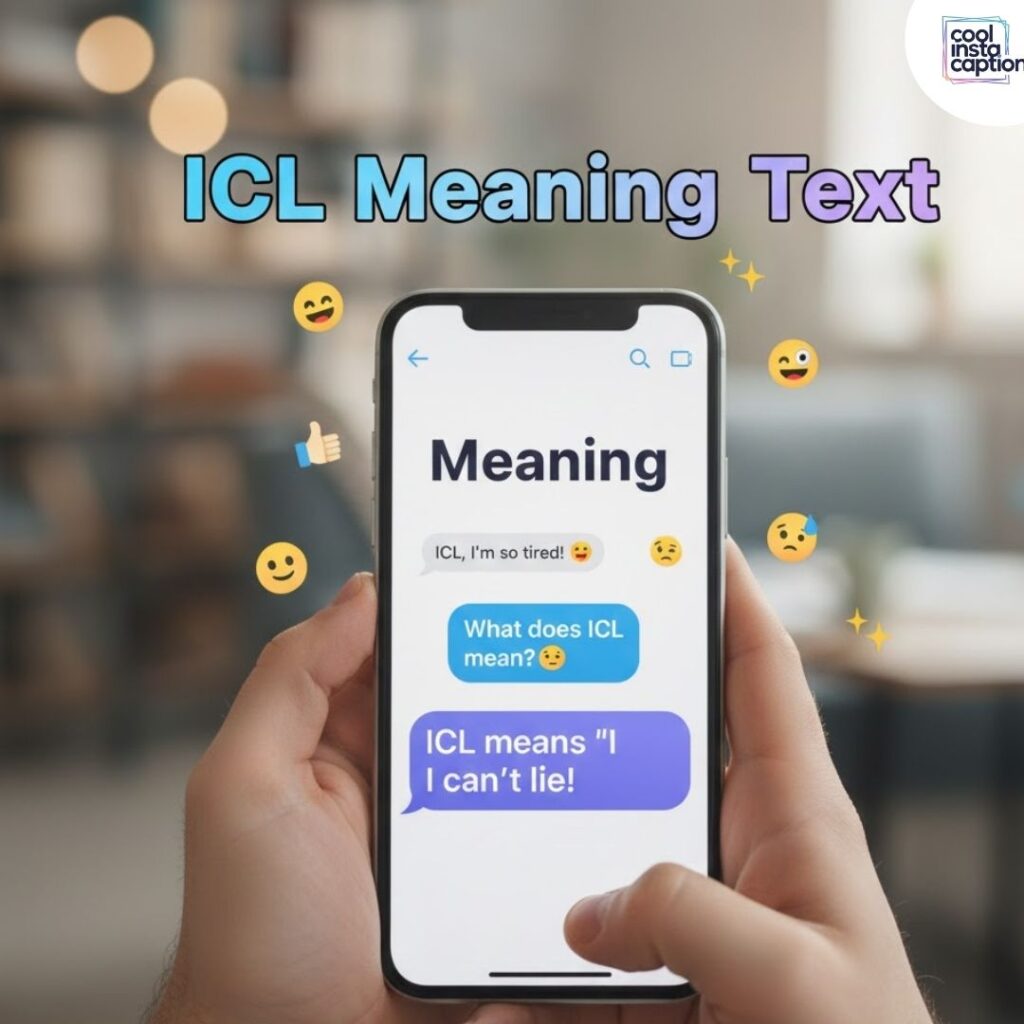
- Definition: Acronym meaning “I Can’t Lie” or “I Cannot Lie”
- Grammatical role: Phrase modifier or conversation opener
- Synonymous expressions: TBH (To Be Honest), NGL (Not Gonna Lie)
- Semantic variation: Authenticity indicator in digital discourse
- Linguistic category: Internet slang and text abbreviation
Real Example: “ICL, that movie was boring 😴”
Background
The abbreviation ICL emerged from internet culture’s obsession with brevity and authenticity. Its roots trace back to early 2010s texting evolution.
- Origin period: Gained traction around 2015-2018
- Platform emergence: Twitter and Snapchat were early adopters
- Cultural drivers: Need for concise, authentic expression
- Evolution pattern: Spread through meme culture and viral content
- Generational adoption: Primarily used by users born after 1995
The phrase evolved as users sought alternatives to overused terms like “honestly” or “actually.” Text-based communication demanded shorter expressions that still conveyed sincerity.
Usage in Different Contexts
Context determines meaning,ICL shifts dramatically between casual chats and professional settings. Understanding these nuances prevents embarrassing misinterpretations.
| Context | ICL Meaning | Example Usage |
| Casual Texting | I Can’t Lie | “ICL, your outfit is fire 🔥” |
| Medical Field | Intraocular Lens | “Patient needs ICL surgery” |
| Aviation | Instrument Commercial License | “She earned her ICL certification” |
| Physics | Ion Cyclotron Layer | “ICL affects particle behavior” |
| Cricket | International Cricket League | “ICL matches start tomorrow” |
- Social media: Honesty emphasis in personal opinions
- Healthcare: Refers to eye surgery implants
- Professional aviation: Pilot licensing terminology
- Scientific research: Plasma physics phenomenon
- Sports broadcasting: Cricket tournament abbreviation
Meaning in Chat, WhatsApp, Instagram, TikTok
On social platforms, ICL serves as a trust-building prefix before sharing genuine thoughts or potentially controversial opinions.
WhatsApp Usage:
- “ICL, I’m not coming to the party 🤷”
- Signals transparent communication with friends
Instagram Comments:
- “ICL this photo is stunning ✨”
- Adds emphasis to compliments or critiques
TikTok Captions:
- “ICL I’ve been crying all day 😭 #relatable”
- Creates authentic connection with viewers
Snapchat Conversations:
- “ICL, he’s not worth your time”
- Delivers advice with friendly honesty
- Function: Prefacing honest or unpopular statements
- Tone: Casual, conversational, and authentic
- Audience: Primarily teens and young adults
- Frequency: Common in personal messaging over public posts
- Impact: Softens potentially harsh truths
What Does ICL Mean in Text
In text messaging, ICL acts as a sincerity signal that prepares the recipient for an honest, sometimes blunt statement.
- Primary definition: “I Can’t Lie” in digital conversations
- Communicative purpose: Establishes transparency before opinions
- Emotional weight: Adds gravity to following statements
- Usage frequency: Increasing among younger demographics
- Contextual flexibility: Works in positive and negative statements
Chat Examples:
Example 1: Friend A: “Do you like my new haircut?” Friend B: “ICL, it’s not your best look”
Example 2: “ICL I’ve been thinking about you all day 💭”
Example 3: “ICL the exam was way harder than expected”
The phrase replaces longer expressions like “to be completely honest with you” while maintaining the same semantic weight.
Meaning in Physics, Medical, and Aircraft Terminology
Professional fields repurpose ICL with entirely different meanings, creating potential confusion outside specialist contexts.
H3: Medical Context – Intraocular Contact Lens
In ophthalmology, ICL refers to a surgically implanted lens for vision correction. This medical procedure serves as an alternative to LASIK surgery.
- Full term: Intraocular Contact Lens or Intraocular Collamer Lens
- Medical purpose: Corrects myopia, hyperopia, and astigmatism
- Procedure type: Refractive eye surgery
- Target patients: Those unsuitable for corneal laser surgery
- Success rate: High patient satisfaction and safety profile
Aviation Context – Instrument Commercial License
Pilots use ICL when discussing certification levels. This represents a significant professional achievement in aviation careers.
- Full term: Instrument Commercial License
- Certification level: Advanced pilot qualification
- Requirements: Extensive flight hours and examinations
- Career impact: Enables commercial piloting opportunities
- Regulatory body: FAA or equivalent national aviation authority
- Training duration: Several months to years depending on program
Physics Context – Ion Cyclotron Layer
In plasma physics, ICL describes a specific phenomenon in magnetic field interactions with charged particles.
- Full term: Ion Cyclotron Layer
- Field: Plasma physics and space science
- Definition: Region where ion cyclotron resonance occurs
- Applications: Space weather prediction, fusion research
- Research relevance: Critical for understanding magnetosphere dynamics
- Technical complexity: Requires advanced physics knowledge
| Field | ICL Stands For | Primary Users |
| Ophthalmology | Intraocular Contact Lens | Eye surgeons, patients |
| Aviation | Instrument Commercial License | Pilots, flight instructors |
| Physics | Ion Cyclotron Layer | Researchers, scientists |
| Texting | I Can’t Lie | Social media users |
| Sports | International Cricket League | Cricket fans, commentators |
Common Misconceptions
Many users confuse ICL with similar abbreviations or misapply it in inappropriate contexts. Clearing these misunderstandings prevents awkward communication errors.
- Misconception 1: ICL always means “I Can’t Lie” Reality: Context determines meaning,medical and technical fields use different definitions
- Misconception 2: ICL is formal language Reality: Highly informal, inappropriate for professional or academic writing
- Misconception 3: ICL and NGL are interchangeable Reality: Subtle tone differences,ICL feels slightly more emphatic
- Misconception 4: Older generations understand ICL naturally Reality: Primarily youth slang, may require explanation for 40+ audiences
- Misconception 5: ICL softens criticism automatically Reality: Honesty marker doesn’t eliminate offense potential
Example of Misuse: ❌ “ICL, the quarterly report shows declining metrics” (too formal) ✅ “ICL, that outfit doesn’t match” (appropriate casual use)
Similar Terms & Alternatives
The digital lexicon offers numerous alternatives to ICL, each with subtle tonal and contextual differences.
| Acronym | Full Form | Usage Context | Tone Difference |
| NGL | Not Gonna Lie | Casual texting | Slightly less formal |
| TBH | To Be Honest | Social media, texts | More neutral tone |
| IMHO | In My Humble Opinion | Forums, comments | Adds humility |
| FR | For Real | Emphasis statements | More casual, affirming |
| Lowkey | Subtly/Secretly | Personal admissions | Less direct |
- NGL (Not Gonna Lie): Most similar alternative, nearly identical usage
- TBH (To Be Honest): Broader application, slightly more formal
- Real talk: Phrase alternative conveying same authenticity
- No cap: Emphasizes truth-telling in hip-hop influenced speech
- Facts: Agreement marker also signaling honesty
Comparative Examples:
“ICL, I forgot your birthday” (emphasizes personal accountability) “NGL, I forgot your birthday” (similar but slightly less weighted) “TBH, I forgot your birthday” (softer, more apologetic tone)
How to Respond to It
When someone uses ICL in conversation, your response should acknowledge their honesty while addressing the content appropriately.
- Acknowledge the honesty: “I appreciate you being real with me”
- Address the content: Respond to what follows ICL, not the acronym itself
- Match the energy: Keep your tone casual if theirs was
- Don’t overreact: ICL signals transparency, not necessarily criticism
- Reciprocate vulnerability: Consider sharing your own honest perspective
Response Examples:
Scenario 1: Receiving Criticism Them: “ICL, your cooking needs work” You: “Haha fair, any tips?”
Scenario 2: Receiving Compliment Them: “ICL, you’re really talented” You: “Thanks! That means a lot 😊”
Scenario 3: Receiving Confession Them: “ICL, I’ve liked you for a while” You: “I’m glad you told me. Let’s talk about this”
Scenario 4: Receiving Opinion Them: “ICL, that movie was trash” You: “Really? I thought it was decent”
Differences from Similar Words
While ICL shares semantic territory with honesty markers, subtle distinctions affect tone and appropriateness in different situations.
ICL vs NGL (Not Gonna Lie)
NGL and ICL occupy nearly identical conversational spaces but carry slight tonal variations that savvy texters recognize and exploit strategically.
- ICL: Implies stronger commitment to truth-telling
- NGL: Sounds slightly more casual and common
- Formality: Both equally informal but NGL more widespread
- Generational use: NGL slightly older in internet years
- Emphasis level: ICL adds marginally more weight to statements
- Frequency: NGL appears more often in actual usage statistics
Example Comparison: “ICL, this party is boring” (stronger dissatisfaction) “NGL, this party is boring” (milder observation)
ICL vs TBH (To Be Honest)
TBH predates ICL in internet slang history and carries a slightly more neutral, less emphatic quality in modern usage patterns.
- TBH: More established, older internet slang
- ICL: Newer, trendier alternative gaining traction
- Context range: TBH works in more situations
- Emotional weight: TBH feels less confrontational
- Professional use: Neither appropriate, but TBH closer to acceptable
- Platform preference: TBH more Facebook/Instagram, ICL more TikTok/Snapchat
Example Comparison: “TBH, I don’t really like seafood” (polite disclosure) “ICL, I hate seafood” (stronger, more definitive)
Relevance in Online Conversations & Dating Apps
Dating platforms have become hotspots for ICL usage, where establishing authenticity quickly can make or break connections.
- Trust building: ICL signals genuine interest or concern
- Vulnerability marker: Shows willingness to be open and honest
- Conversation deepener: Moves chat beyond surface-level pleasantries
- Risk factor: Excessive use may seem unnecessarily dramatic
- Context sensitivity: Works better in established conversations than openers
Dating App Examples:
Tinder Conversation: Match: “What are you looking for?” You: “ICL, something real, not just hookups”
Bumble Exchange: “ICL, your profile made me laugh out loud 😂”
Hinge Message: “ICL, I’ve never tried sushi either! Want to change that together?”
| Scenario | ICL Usage | Effect |
| Complimenting photos | “ICL, you’re gorgeous” | Direct, confident |
| Sharing preferences | “ICL, I’m not a party person” | Establishes boundaries |
| Expressing interest | “ICL, I’d love to meet you” | Shows genuine enthusiasm |
| Gentle honesty | “ICL, long distance won’t work for me” | Clear, respectful rejection |
| Vulnerability | “ICL, dating apps intimidate me” | Creates relatable connection |
How to Reply When Someone Says ICL
Your response strategy depends on what follows the ICL marker,whether it’s positive, negative, neutral, or vulnerable content.
- Positive ICL: Respond with gratitude and reciprocate warmth
- Negative ICL: Stay calm, ask for clarification if needed
- Vulnerable ICL: Show appreciation for their openness
- Opinion ICL: Engage with the substance, not the acronym
- Humorous ICL: Match their playful tone with your own
Response Framework:
Step 1: Process the actual message content Step 2: Acknowledge their honesty implicitly Step 3: Formulate response to the substance Step 4: Keep tone aligned with theirs
Detailed Examples:
Example 1: Critical Feedback Them: “ICL, you’ve been distant lately” You: “You’re right, I’m sorry. Work’s been crazy but that’s no excuse. Let’s hang out this week?”
Example 2: Compliment Them: “ICL, your presentation was incredible” You: “Thank you! That really means a lot coming from you”
Example 3: Confession Them: “ICL, I’m scared about the future” You: “I get that. Want to talk about what’s worrying you?”
Example 4: Opinion Them: “ICL, pineapple belongs on pizza” You: “I respect your honesty but that’s still wrong 😂”
Is ICL Still Popular? Trends & Online Usage
Current data suggests ICL maintains steady usage across platforms, though its popularity varies by demographic and geographic region.
- Overall trend: Stable usage since 2020, slight growth in 2023-2024
- Platform dominance: TikTok shows highest ICL frequency
- Demographic concentration: 16-28 age group primary users
- Geographic spread: Strongest in English-speaking countries
- Competition: NGL still more common overall, but ICL gaining ground
| Platform | ICL Usage Level | Trending Direction |
| TikTok | Very High | ↑ Increasing |
| Snapchat | High | → Stable |
| Moderate | → Stable | |
| Moderate | ↑ Increasing | |
| Twitter/X | Low-Moderate | → Stable |
Search trends indicate consistent interest in what does ICL mean, suggesting new users continually discover the term while existing users integrate it naturally into vocabulary.
The phrase remains culturally relevant particularly in contexts requiring quick authenticity signals,dating apps, friend groups, and influencer-audience interactions all sustain ICL’s linguistic lifespan.
Prediction: ICL will likely remain part of digital vocabulary for the next 3-5 years before potentially being replaced by newer variations, following typical internet slang lifecycle patterns observed with similar terms.
Frequently Asked Questions
What does ICL meaning in text?
What does ICL mean in texting is “I Can’t Lie,” used to emphasize honesty before sharing genuine opinions or feelings.
Is ICL the same as NGL?
What does ICL mean compared to NGL shows slight differences,ICL emphasizes truth slightly stronger, though both signal honesty effectively in texts.
Can ICL be used professionally?
What does ICL mean in professional settings varies,in casual texts it’s “I Can’t Lie,” but avoid this in formal communications.
What does ICL stand for in medical terms?
What does ICL mean medically refers to Intraocular Contact Lens, a surgical eye implant for vision correction, completely different from texting slang.
How do you respond when someone says ICL?
What does ICL mean for responses requires acknowledging their honesty and addressing the actual content they shared after the abbreviation naturally.
Conclusion
Understanding ICL meaning empowers you to navigate modern digital communication with confidence and cultural fluency. Whether you encounter it in casual texts, dating apps, or professional contexts, recognizing the difference between “I Can’t Lie” and technical terminology prevents confusion.
The ICL meaning continues evolving as language adapts, but its core function,signaling authenticity,remains consistent across platforms. Master this abbreviation, and you’ll decode conversations more effectively while connecting genuinely with others.
