

Have you ever felt a surge of peace after a long day, or a sudden spark of joy when seeing a loved one? That feeling is the essence of “Alhamdulillah,” a powerful phrase that transcends language to connect the human soul with its Creator. Understanding the Alhamdulillah Meaning is like finding a key to lasting contentment in an often chaotic world. It is not just a word; it is a spiritual frequency that aligns your heart with the divine rhythm of the universe.
Gratitude is more than a polite gesture; it is a spiritual superpower that transforms your perspective and invites more blessings into your life. By mastering the Alhamdulillah Meaning, you unlock a heart-centered way of living that fosters resilience, mindfulness, and a deep sense of belonging within the Islamic faith and beyond. It teaches us that even in the silence of our struggles, there is a reason to give thanks.
Alhamdulillah: Meaning, Translation, and Usage in Islam
In Islamic tradition, this phrase is the cornerstone of a believer’s vocabulary, representing a lifestyle of constant gratitude. It is used to acknowledge that every breath, success, and even every trial is a gift from the Divine. It is the first word of the Quran and the last word of the people of Paradise.
- Universal Praise: It is the first phrase many Muslims utter upon waking, acknowledging the gift of life.
- Spiritual Anchor: It keeps the heart grounded during moments of extreme success, preventing arrogance.
- Daily Remembrance: It is integrated into the five daily prayers (Salah) at least 17 times a day.
- Cultural Bridge: It is used by Arabic speakers of various faiths to show general thanks for life.
- Emotional Shield: It helps practitioners maintain a positive outlook during hardships by seeking the hidden mercy.
| Aspect | Description |
| Primary Focus | Absolute and total gratitude to Allah alone |
| Theological Weight | Considered the best form of Supplication (Dua) |
| Frequency | Used dozens of times daily by practicing Muslims |
| Intent | Internalizing that all “Hamd” (praise) belongs to God |
| Spiritual State | Transitioning from a state of complaint to a state of Ridha (Contentment) |
What is Alhamdulillah Meaning?
The phrase is a profound declaration that shifts the focus from the self to the Creator. While often translated as “Praise be to God,” the Alhamdulillah Meaning encompasses a deep sense of appreciation, recognition of mercy, and total submission to the will of Allah. It is the verbalization of a heart that is satisfied with its decree, regardless of outward circumstances.
In the science of NLP (Neuro-Linguistic Programming), repeating such a positive affirmation recharges the subconscious mind. When a believer says it, they are performing a cognitive reframing of their reality. They are choosing to see the “glass half full” because the glass itself was provided by the Creator. This semantic depth is what makes it the “best of dhikr.”
What does Alhamdulillah mean in English?
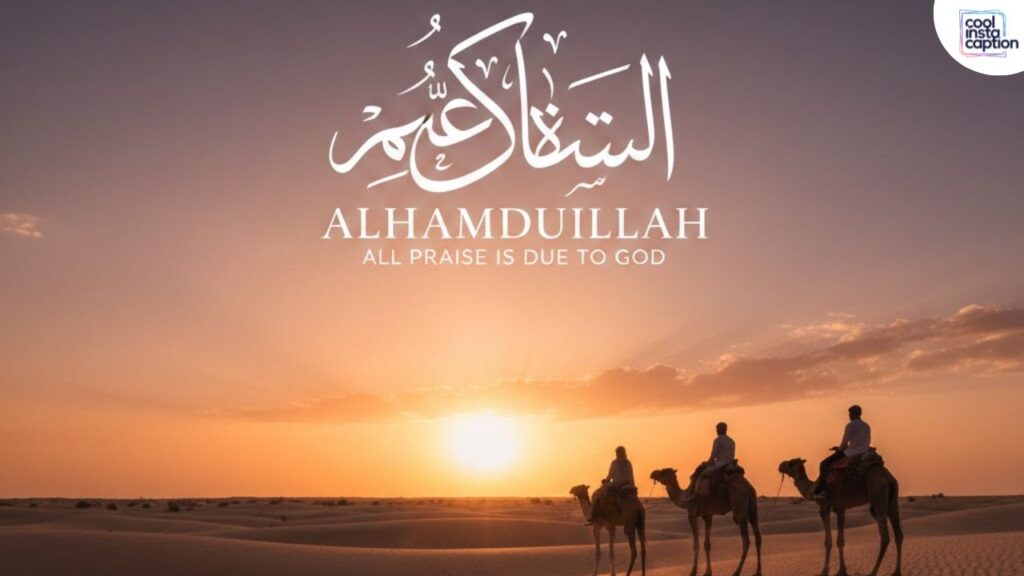
In English, the most common translation is “Praise be to Allah” or “All praise is due to God.” However, English words often struggle to capture the nuances of Hamd, which implies praise coupled with love and reverence. It functions as both a “thank you” and a “glory be” simultaneously, creating a bridge between the servant and the Divine.
- Linguistic Depth: Unlike “thanks,” it implies that the recipient is inherently worthy of praise regardless of the gift.
- Versatility: It is used for both big miracles, like a new child, and small daily comforts, like a cool breeze.
- Recognition: It acknowledges God as the source of all provisions (Rizq) and sustenance.
- Theological Bond: It connects the servant to the Master through vocalized appreciation and humility.
- Positive Affirmation: It acts as a psychological tool to focus on abundance rather than lack.
What does Alhamdulillah mean in Arabic?
In its original Arabic, the phrase consists of three parts: “Al” (The), “Hamdu” (Praise), and “Lillah” (to Allah). The Arabic structure suggests that all forms of praise, past, present, and future, belong exclusively to the Almighty. It is a linguistic masterpiece of brevity and depth that carries the weight of the entire Islamic creed (Tawhid).
- Root Word: Derived from H-M-D, signifying sincere appreciation and recognition of beauty.
- Definite Article: The “Al” makes the praise universal, absolute, and all-encompassing for all time.
- Grammatical Weight: It is a nominal sentence, implying a permanent and timeless state of existence.
- Phonetic Beauty: The breathy “h” sounds evoke a sense of relief, peace, and spiritual release.
- Sacred Origin: It is the opening statement of the Holy Qur’an, setting the tone for the entire revelation.
Alhamdulillah in the Qur’an
The Qur’an begins with this phrase in Surah Al-Fatiha, establishing it as the fundamental theme of the Islamic message. It appears throughout the text to remind believers of God’s creative power, His mercy, and the importance of being among the Shakirun (grateful ones). The Quran links gratitude directly to an increase in blessings.
- Surah Al-Fatiha: The “Opening” chapter starts with this declaration, making it essential for every prayer.
- Signs of Creation: Used when describing the complex and perfect creation of the heavens and the earth.
- Prophetic Legacy: Many Prophets, including Noah and Abraham, used this phrase during their specific trials.
- End of Affairs: It is said that the inhabitants of Paradise will end their prayers with this very phrase.
- Divine Promise: The Qur’an promises that “If you are grateful, I will surely increase you” (Surah Ibrahim).
| Surah Name | Verse Reference | Context |
| Al-Fatiha | 1:2 | Opening the prayer and the Book |
| Al-An’am | 6:1 | Creation of heavens, earth, and light |
| Ibrahim | 14:39 | Ibrahim’s gratitude for his sons in old age |
| Al-Kahf | 18:1 | Revelation of the Book to His servant |
| Fatir | 35:1 | Praise for the Creator of the Angels |
Alhamdulillah meaning in Urdu
In the Urdu language, “Alhamdulillah” is used identically to Arabic but carries the cultural weight of South Asian piety. It is often paired with “Shukar,” as in “Shukar Alhamdulillah,” emphasizing the act of giving thanks for the specific blessings bestowed upon an individual. In Pakistan and India, it is a staple of polite conversation.
- Cultural Integration: Deeply embedded in daily Urdu greetings, farewells, and dinner table etiquette.
- Formal Usage: Used in formal speeches and classical literature to show humility and God-consciousness.
- Common Response: The standard, reflexive reply when someone asks “How are you?” (Aap kaise hain?).
- Synonymous with Shukr: Frequently translated or explained as “Khuda ka shukar” (Thanks to God).
- Spiritual Poetry: Often found in Urdu Naats, Qawwalis, and Hamds (poems strictly for praise).
Hamdullah or Alhamdulillah
“Hamdullah” is a shortened, colloquial version of “Alhamdulillah.” While “Alhamdulillah” is the complete and grammatically perfect form found in the Qur’an, “Hamdullah” is frequently used in casual conversation across the Middle East and North Africa to express the same sentiment in a faster, more condensed way.
- Slang vs. Formal: Hamdullah is conversational and regional; Alhamdulillah is liturgical and scriptural.
- Regional Variance: Extremely common in Levantine (Lebanese, Syrian) and Egyptian dialects.
- Speed of Speech: Often used when speaking quickly, like saying “Thanks” instead of “Thank you.”
- Intention: Both carry the same spiritual weight and intention of gratitude to the Creator.
- Acceptability: Both are understood and accepted, though “Alhamdulillah” is preferred in formal prayer.
Alhamdulillah pronunciation
Correct pronunciation ensures the spiritual and linguistic integrity of the phrase. It is pronounced as Al-ham-du-lil-lah. The “h” in “Hamdu” is a deep, pharyngeal sound from the throat (Ha), distinct from the English “h” in “house” or “hello.” Mastering this sound is part of learning Tajweed.
- Phonetic Breakdown: Al (as in pal) – Ham (deep h) – du (as in do) – lil – lah.
- Emphasis: The stress is often placed on the “lah” at the end to elongate the Divine name.
- Breath Control: Requires a clear expulsion of air from the middle of the throat for the “H.”
- Common Mistakes: Avoid pronouncing the “H” too softly or like a “K” (Kh).
- Learning Tip: Listen to famous Qaris (reciters) like Mishary Rashid to master the guttural Arabic “H.”
Just say Alhamdulillah Meaning in Urdu
In the context of “Just say Alhamdulillah,” the Urdu meaning implies “Bas Alhamdulillah kaho.” This is a common piece of advice given to someone going through a hard time, encouraging them to trust in God’s plan and remain patient through vocalized gratitude. It is the ultimate remedy for a restless soul.
- Patience (Sabr): Encourages staying quiet and thankful even when the wisdom of a trial is hidden.
- Contentment (Raza): Being happy with whatever God has provided, whether it is a little or a lot.
- Social Advice: A way to comfort a grieving or stressed friend by reminding them of God’s presence.
- Spiritual Remedy: Believed to calm the heart and reduce anxiety by shifting focus to the Divine.
- Urdu Nuance: Often implies that “God knows best,” and our job is simply to remain grateful.
Alhamdulillah meaning in Hindi
In Hindi, the meaning is essentially “Ishwar ki stuti” or “Bhagwan ka shukriya.” Because Urdu and Hindi share many colloquial roots, many Hindi speakers understand “Alhamdulillah” as a way of saying “God be praised” for a positive outcome, good health, or escaping a dangerous situation.
- Inter-faith Understanding: Widely recognized in Bollywood movies and secular Indian literature.
- Literal Meaning: “Sab tareef Allah ke liye hai” (All praise is for Allah).
- Usage: Used primarily by Indian Muslims but understood and respected by Hindi-speaking neighbors.
- Translation: Often equated to “Dhanyawad” or “Abhaar” in a spiritual, divine context.
- Commonality: Reflects the shared linguistic heritage and syncretic culture of the Indian subcontinent.
Alhamdulillah meaning Christianity
While an Islamic phrase, the sentiment of “Alhamdulillah” is mirrored in Christianity by “Hallelujah” (Praise the Lord). Arab Christians also use “Alhamdulillah” because “Allah” is the Arabic word for God, regardless of the religion of the speaker. It is a term of monotheistic unity.
- Common Root: Both phrases center on the concept of “Praise” (Hamd / Hallel).
- Arab Christian Usage: It is a standard part of the Arabic language used by Christians in Lebanon, Egypt, and Jordan.
- Biblical Parallel: Similar to the Psalms that say, “Give thanks to the Lord, for He is good.”
- Shared Values: Highlights the universal human need to express gratitude to a higher Creator.
- Linguistic Context: In Arabic-speaking countries, it is a cultural expression of “Thank God” used by everyone.
Shukar Alhamdulillah meaning
“Shukar Alhamdulillah” combines the Persian/Urdu word for “thanks” (Shukr) with the Arabic phrase. It translates to “Thanks and Praise be to Allah.” It is a double affirmation of gratitude, acknowledging both the specific benefit received and the Greatness of the Giver. It is the peak of South Asian devotional language.
- Double Gratitude: Acknowledges the specific blessing (Shukr) and the General Creator (Hamd).
- Intense Appreciation: Used when something particularly good happens, like a wedding or health recovery.
- South Asian Flavor: Highly popular in Pakistan, India, and Bangladesh as a default “feel good” phrase.
- Daily Greeting: Often the first thing said after a meal, finishing a job, or seeing a friend.
- Spiritual Completion: Combines the human act of thanking with the spiritual act of praising God’s attributes.
Different Variations of Alhamdulillah
There are several ways to expand upon the basic phrase to add specific meaning or intensity. These variations are often taken from the Sunnah (the practice of the Prophet Muhammad, peace be upon him) to cover different life situations, from extreme joy to deep sorrow.
- Alhamdulillah ala kulli hal: “Praise be to Allah in all circumstances” (used specifically in hardship).
- Alhamdulillah hamdan kathiran: “Praise be to Allah, much praise” (used during moments of great joy).
- Alhamdulillah illadhi bi ni’matihi tatimmus-salihat: “Praise be to Allah by whose favor good works are accomplished.”
- Ya Rabbi lakal hamdu: “O my Lord, to You belongs all praise, as befits the Majesty of Your Face.”
- SubhanAllah wa bihamdihi: “Glory be to Allah and His is the praise” (repeated 100 times for forgiveness).
| Variation | When to Use | Detailed Meaning |
| Ala kulli hal | During trials or illness | Praise to God regardless of the current difficulty |
| Hamdan Kathiran | After a major achievement | Abundant, pure, and blessed praise |
| Bi ni’matihi | Finishing a project/task | Recognizing that success only came through His favor |
| Lakal Hamd | During and after prayer | Personalizing the praise: “To You belongs the praise” |
| Tayyiban Mubarakan | After eating or drinking | Pure and blessed praise for sustenance |
Benefits of Saying Alhamdulillah
The spiritual and psychological benefits of this phrase are immense. It shifts the brain from a state of “scarcity” (focusing on what is missing) to a state of “abundance” (focusing on what is present). This is a core tenant of modern positive psychology and mindfulness.
- Increased Blessings: The Qur’an explicitly promises that gratitude results in more gifts from God.
- Mental Peace: Reduces cortisol and anxiety by training the heart to be satisfied with the present moment.
- Humility: Acts as a constant ego-check, preventing pride from taking over one’s successes.
- Reward in Hereafter: It is described as a phrase that fills the “Balance” (Mizan) on the Day of Judgment.
- Stronger Connection: Build a constant, conversational relationship with the Creator throughout the day.
When Should We Say Alhamdulillah?
There is no “wrong” time to say it, but certain moments are traditionally emphasized in Islamic practice. It turns mundane actions into acts of worship simply by adding a layer of conscious gratitude. It is the ultimate “mindfulness” tool for the busy modern person.
- After Eating: To thank the Provider for the energy and the taste of the food.
- Upon Sneezing: A Sunnah practice that recognizes the body’s reflexive health.
- Waking Up: Recognizing the “gift of another day” after the soul returns from sleep.
- During Hardship: To show trust in God’s wisdom, even when the current path is painful.
- When Asked “How are you?”: To signal that one is satisfied with God’s decree, no matter what.
How Should I Reply to Alhamdulillah?
The reply depends on the context of the conversation. The most famous exchange happens after someone sneezes. However, in general conversation, the reply is often a supportive phrase that reinforces the spirit of gratitude and mutual blessing.
- YarhamukAllah: “May Allah have mercy on you” (The mandatory reply after someone sneezes).
- Yahdikumullah: “May Allah guide you” (The response back to the person who said YarhamukAllah).
- BarakAllah: “May Allah bless you” (Commonly said when someone shares their success).
- MashaAllah: “As Allah has willed” (To acknowledge the blessing and protect it from envy).
- Ameen: “May it be so” (Used if the phrase was uttered as a hopeful prayer).
Real Chat Example:
- Sarah: “I finally got the job offer I was waiting for, Alhamdulillah!”
- Aisha: “MashaAllah! That is amazing news. May there be much Barakah in it.”
- Sarah: “Thank you, I’m just so relieved and grateful right now.”
Should I Say MashAllah or Alhamdulillah?
While both are phrases of praise, they serve different psychological and spiritual purposes. “MashaAllah” is used to express appreciation for something beautiful while attributing it to God’s will. “Alhamdulillah” is a direct expression of your own gratitude for a benefit.
- MashaAllah: Focuses on God’s Will (The Cause of the beauty).
- Alhamdulillah: Focuses on God’s Praise (The Result of the blessing).
- Example: Use MashaAllah for someone else’s achievement; use Alhamdulillah for your own.
- Protection: MashaAllah is traditionally used to ward off the “evil eye” (Hasad).
- Gratitude: Alhamdulillah is the primary engine for increasing one’s own spiritual rank and happiness.
How Many Quranic Surahs Begin with “Alhamdulillah”?
There are exactly five Surahs in the Holy Qur’an that begin with this sacred phrase. These Surahs are often referred to as the “Hamidat” and they cover the spectrum of God’s majesty, from the creation of the world to the sending of revelation.
- Surah Al-Fatiha (Chapter 1): The “Mother of the Book,” establishing the basis of worship.
- Surah Al-An’am (Chapter 6): A long chapter discussing the oneness of God and the physical world.
- Surah Al-Kahf (Chapter 18): A weekly recitation for many, focusing on protection and faith.
- Surah Saba (Chapter 34): Discusses the history of nations and God’s ultimate sovereignty.
- Surah Fatir (Chapter 35): Highlights God as the Originator who creates whatever He wills.
| Surah Number | Surah Name | Key Theme of Praise |
| 1 | Al-Fatiha | God’s Mercy and Guidance |
| 6 | Al-An’am | Creation of Light and Darkness |
| 18 | Al-Kahf | Protection and Knowledge |
| 34 | Saba | Mastery over the Heavens |
| 35 | Fatir | Sustaining all living things |
Can Non-Muslims Say Alhamdulillah?
Yes, anyone can say it. Since “Allah” is simply the Arabic word for “The One God,” any person who wishes to express their gratitude to the Creator in the Arabic language can use the phrase. It is a linguistic expression of a universal human emotion that knows no borders.
- Cultural Respect: It is often seen as a sign of appreciation for Arabic culture and language.
- Universal Truth: The concept of giving thanks to a higher power is shared by billions globally.
- Arab Christians: Use it daily as a natural part of their native vocabulary.
- Secular Usage: Sometimes used loosely to mean “thankfully” or “I’m glad that’s over.”
- No Restriction: There is no religious “copyright” on the phrase; it is a gift for all of humanity.
Do I say mashallah or Alhamdulillah?
Determining which one to use depends on the situation. Often, Muslims use both in the same sentence to cover all spiritual bases—recognizing God’s power and expressing their own joy. It creates a complete circle of God-consciousness.
- MashaAllah: Use when you are an observer of something good (e.g., a nice house).
- Alhamdulillah: Use when you are the recipient of something good (e.g., a promotion).
- The Difference: MashaAllah = God’s decree; Alhamdulillah = My gratitude.
- Combined: “MashaAllah, your garden is so beautiful, Alhamdulillah for the rain.”
- Social Etiquette: Saying MashaAllah for others is a way to show you are not jealous.
Real Chat Example:
- Omar: “Look at this photo of my new car!”
- Zaid: “MashaAllah, it’s a beautiful color! You deserved it.”
- Omar: “Thanks man, Alhamdulillah it finally arrived after months of waiting.”
FAQS:
What is the simplest Alhamdulillah Meaning?
The Alhamdulillah Meaning is “Praise be to God,” used to express gratitude for all life’s blessings. It’s the ultimate way to thank the Creator.
When should I use the Alhamdulillah Meaning in conversation?
Use the Alhamdulillah Meaning after finishing a meal, when someone asks about your health, or when you receive a blessing.
Is the Alhamdulillah Meaning different from SubhanAllah?
Yes, the Alhamdulillah Meaning focuses on praise and gratitude, while SubhanAllah means “Glory be to God,” focusing on His divine perfection.
Can I use the Alhamdulillah Meaning during hard times?
Absolutely, using the Alhamdulillah Meaning during trials shows a high level of faith and trust that God’s plan is always best.
Why is the Alhamdulillah Meaning important in daily life?
The Alhamdulillah Meaning builds a positive mindset, reduces feelings of envy, and reminds us that every breath is a gift from the Divine.
Conclusion:
In conclusion, embracing the spirit of gratitude through this powerful phrase can truly transform your life and mental well-being. Whether you are reciting Alhamdulillah in arabic during your formal prayers or simply whispering it after a long day of work, you are tapping into a timeless tradition of divine praise.
By understanding the depth of this expression, you move closer to a state of inner peace and lasting contentment. Remember that every moment is an opportunity to recognize the divine favors surrounding you. Consistently using Alhamdulillah in arabic ensures that your heart remains humble, your soul stays connected to its source, and your life remains filled with the light of sincere gratitude.
