

Imagine standing at a crossroads where your word is all you have to offer. In those moments of raw vulnerability, the term Wallahi meaning emerges as a bridge between your heart and the Divine. It is more than a linguistic habit; it is a sacred anchor for the soul.
When you speak this word, you are not just talking; you are inviting the Creator to testify to your sincerity. It transforms a simple conversation into a spiritual contract, ensuring that your honesty remains as unbreakable as your faith itself.
What Does Wallahi Meaning? and Usage Explained
The term serves as a powerful linguistic tool to confirm one’s truthfulness by invoking the name of the Creator. In the modern world, it bridges the gap between casual conversation and solemn religious commitments.
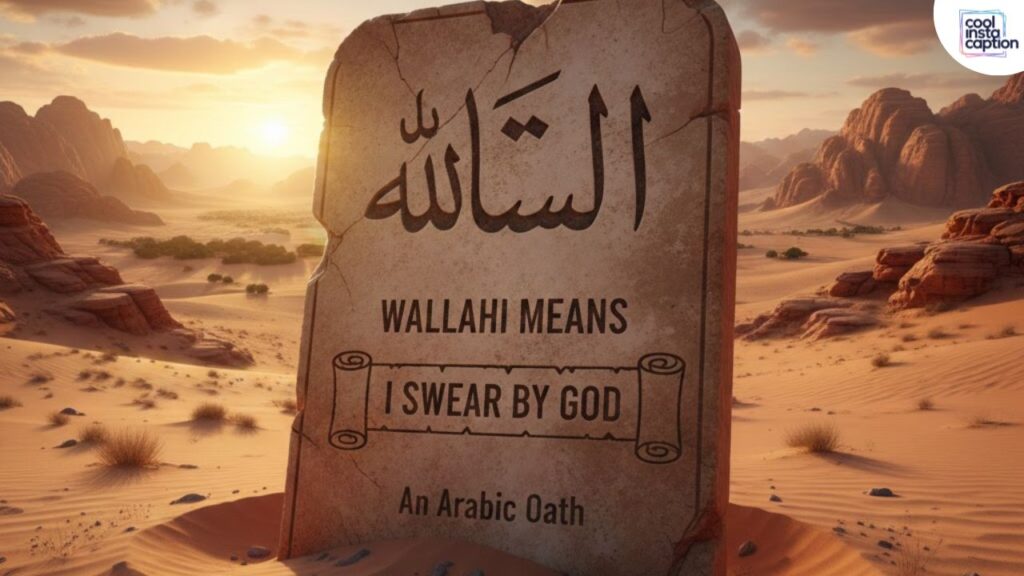
- Primary Definition: It literally translates to “I swear by Allah.”
- Cultural Function: Used to provide absolute reassurance in social interactions.
- Linguistic Roots: Combines the particle “Wa” (oath) with the name of God.
- Modern Reach: Popularized globally through music, media, and multicultural exchange.
- Core Purpose: To remove doubt and establish a foundation of mutual trust.
| Feature | Description |
| Literal Meaning | By Allah / I swear by God |
| Grammatical Role | A prepositional phrase of oath |
| Common Intent | Affirmation and Sincerity |
The Deepest Significance: Wallahi Meaning in Islam
In the Islamic faith, this expression is a formal act known as Qasam or Hulf. It is a heavy weight upon the tongue, as it places the speaker’s relationship with the Divine as collateral for their statement.
- Sacred Covenant: It is viewed as a binding agreement with the All-Knowing.
- Theological Impact: Reflects a person’s Aqeedah (creed) and belief in God’s omniscience.
- Legal Standing: In Sharia, specific oaths can have legal ramifications in testimony.
- Moral Weight: Using it falsely is considered a Major Sin (Al-Kabira).
- Prophetic Guidance: The Messenger of Allah (PBUH) cautioned against excessive swearing.
Wallahi Meaning In English
In English, the phrase is most accurately rendered as “I swear by God” or “By Allah.” While it sounds like “I promise,” the English equivalent often lacks the inherent religious “Qasam” found in the original Arabic. It is a declaration of absolute certainty.
- Direct Translation: “By God” or “I swear.”
- Contextual use: Often used where an English speaker might say “For real” or “Seriously.”
Wallahi meaning in Islam
Within the framework of Iman (faith), this oath is a serious theological commitment. A Muslim invokes the Attributes of Allah to witness their truth. It is not a triviality but a spiritual testimony that requires deep Niyyah (intention) and absolute honesty.
- Spiritual Bond: Connects the speaker’s word to their eternal accountability.
- Expiation: Breaking such an oath requires Kaffarah (feeding the poor or fasting).
Wallahi pronunciation
Properly articulating the word is essential for its meaning. It is pronounced as wal-LAA-hee, with a clear emphasis on the middle syllable and a soft “h” sound at the end. The “a” in Allah is prolonged to show respect and linguistic accuracy.
- Syllables: Wal-lah-i.
- Phonetic Guide: /wa-ɫ-ɫaː-hi/.
Wallahi Billahi Meaning
This combination, along with Tallah, represents the three traditional ways to take an oath in Arabic. Billahi means “with/by Allah,” often used to seek help or add layers of intensity to a vow. Together, they create an unbreakable chain of testimony.
| Term | Meaning | Specific Use |
| Wallahi | By Allah | General Oath |
| Billahi | With/In Allah | Seeking Help/Vow |
| Tallahi | By Allah (Exclusive) | Strongest, rare oath |
Wallahi Meaning in Arabic
Grammatically, the “Wa” is a Waw al-Qasam (the ‘Waw’ of swearing). It transforms the following noun into a genitive case. In its purest Arabic form, it is the standard way to testify to the truth in both formal and informal registers.
- Arabic Script: وَاللّٰهِ.
- Grammar: Prepositional phrase indicating a solemn vow.
Wallahi Meaning Christian
While rooted in Islamic culture, Arab Christians also use the term because “Allah” is simply the Arabic word for God. In Christian contexts, it remains an oath to the Creator, though the theological consequences of Kaffarah may differ from Islamic law.
- Universal Use: Shared by all Arabic speakers regardless of religion.
- Context: Used in Bibles and liturgy in the Arabic-speaking world.
Wallahi meaning in hindi
In South Asia, particularly in Urdu and Hindi, the term is borrowed directly from Arabic. It is used among Muslim communities to emphasize truth. It is often synonymous with “Khuda ki Kasam” (Swearing by God) in the local linguistic landscape.
- Regional Variation: Used similarly to the Arabic original.
- Cultural Integration: Frequently heard in Bollywood and street slang.
Wallahi meaning vs wallah
The primary difference is formality. Wallahi is the grammatically complete version, while Wallah is a colloquial contraction. In some dialects, “Wallah?” is used as a question to ask “Really?” or “Are you serious?” to another person.
- Wallahi: Formal, personal, and grammatically complete.
- Wallah: Casual, often used as a rhetorical question.
Origin and Definition of Wallahi
The origins of the term trace back to pre-Islamic Arabic, where oaths were a central part of tribal honor. With the advent of Islam, the practice was refined to ensure that oaths were only taken in the name of the Creator, elevating the Wallahi meaning to a divine status.
- Etymology: Rooted in the Semitic “W” (prefix for oath) and “Allah.”
- Historical Shift: Transitioned from tribal vows to monotheistic testimony.
- Linguistic Purity: Maintains its classical structure across centuries.
- Global Spread: Migrated through trade and religious expansion.
- Formalization: Codified in Islamic jurisprudence as a binding verbal act.
| Era | Primary Usage | Cultural Weight |
| Pre-Islamic | Tribal Honor | High |
| Classical Islamic | Legal/Religious Oath | Absolute |
| Modern Day | Social/Emphasis | Varied |
Wallahi in the Quran?
While the exact phrase appears in various forms of oaths throughout the Quran, the concept of swearing by the Lord is a recurring theme. The Divine Himself takes oaths by His creation to emphasize the gravity of the message being delivered to mankind.
- Divine Oaths: Allah swears by the sun, the moon, and time.
- Human Oaths: The Quran guides believers to be truthful when they swear.
- Sincerity: Emphasizes that God knows the secrets of the hearts.
- Consequences: Warns against taking the name of God in vain.
- Consistency: The Quranic message reinforces the sanctity of the Wallahi meaning.
The Practical Guide: How and When to Use Wallahi
Using this oath requires a balance of faith and social awareness. It is not a tool for manipulation but a shield for your integrity. One must ensure their heart matches their tongue before uttering these powerful syllables in any conversation.
- Verify Truth: Never use it if there is a shred of doubt.
- Assess Necessity: Ask if a simple “I promise” is sufficient.
- Respect the Name: Remember the holiness of the word being used.
- Consider the Audience: Use it where its weight is understood.
- Avoid Overuse: Frequent swearing can diminish your overall credibility.
When to say Wallahi?
The timing of an oath is just as important as the words themselves. It should be reserved for moments of significance where truth must be established beyond any reasonable doubt, ensuring that the Wallahi meaning remains impactful and respected.
- Serious Commitments: When making life-changing promises.
- Resolving Disputes: To end a conflict by swearing the truth.
- Testimony: When called upon to bear witness to an event.
- Personal Integrity: To clear your name of false accusations.
- Sacred Vows: During religious or formal covenants.
Scenario 1: Bearing Witness (Shahada)
In legal or formal settings, such as a courtroom or a community dispute, saying Wallahi acts as a verbal signature. It signifies that you are providing a truthful account of events under the watchful eye of the Divine.
Example Chat:
User A: “Did you see who broke the window?”
User B: “Wallahi, I saw the whole thing. It was the neighbor’s kid.”
Scenario 2: Making a Solemn Vow or Promise
When a simple “I’ll try” isn’t enough, this oath transforms a promise into a debt. It tells the other person that you are so committed to your word that you are willing to answer to God for its fulfillment.
Example Chat:
Friend A: “Can I trust you to pay me back by Friday?”
Friend B: “Wallahi, I will have the money for you. Don’t worry.”
Scenario 3: Defending One’s Honor and Integrity
If someone accuses you of something you didn’t do, this phrase serves as your ultimate defense. It is a way to stake your reputation on the truth, signaling to others that your conscience is clear before the Creator.
Example Chat:
Colleague: “I heard you leaked the project details.”
You: “Wallahi, I have never spoken to anyone about that. That’s a lie.”
How to swear using Wallahi?
Taking an oath is a three-step process that involves the heart, the tongue, and the mind. It is a holistic act of worship and social responsibility that requires the speaker to be fully present and sincere in their declaration.
- Internal Alignment: Ensure your intention is pure.
- Clear Utterance: Speak the words distinctly and firmly.
- Awareness: Understand the spiritual baggage attached to the oath.
- Honesty: Only swear to what you know for certain.
- Follow-through: Be prepared to fulfill the oath at all costs.
The Intention (Niyyah):
Before the word even leaves your lips, your heart must be set on the truth. In Islam, actions are judged by intentions. Swearing without a sincere Niyyah to tell the truth or fulfill a promise renders the oath meaningless and potentially sinful.
- Heart-Check: Are you using the word to hide something or reveal truth?
- Sincerity: Your inner state must mirror your outward speech.
2. The Utterance (Lafẓ):
The verbal expression must be clear. Mumbling or using the word as a filler (Laghw) is discouraged. To truly honor the Wallahi meaning, the pronunciation should be deliberate, showing respect for the name of Allah that you are invoking.
- Clarity: Speak the syllables with purpose and weight.
- Dignity: Avoid using the phrase in fits of anger or jest.
Understanding the Consequences:
Swearing by God is not a free pass; it is a liability. If you break a Wallahi oath, you are required to perform Kaffarah. This might involve feeding ten needy people or fasting for three days, reminding you of the word’s gravity.
- Spiritual Debt: A broken oath is a mark on one’s record.
- Expiation: The process of making amends for a failed vow.
Common Misconceptions About Wallahi
Despite its sacred nature, many people misunderstand the proper application of this term. Misuse has led to a dilution of its power in some circles, making it vital to clarify what the oath is—and what it definitely is not.
- Not Slang: It should never be used like “yo” or “for real.”
- Not a Tool: You cannot use it to manipulate others into believing a lie.
- Not a Filler: It shouldn’t be used to fill gaps in conversation.
- Formal vs. Informal: There is a distinct difference between the two.
- Sacredness: The word carries a weight that “I swear” simply does not.
Myth 1: “It’s just a slang word like ‘I swear’ or ‘for real’.”
While it is used frequently in pop culture, the Wallahi meaning is deeply religious. Using it as a casual interjection strips it of its spiritual significance. It is a formal oath, not a trendy catchphrase for social media captions.
- Reality Check: It is a theological commitment, not a linguistic accessory.
- Usage: Treat it with the same respect you would a prayer.
Myth 2: “You can say it for anything to make people believe you.”
Some believe that saying the word automatically makes them believable. However, using it to cover a lie is a Ghamus (a “submerging” lie) that drowns the liar in sin. Trust is earned through consistent honesty, not just a verbal formula.
- Danger: Lying under this oath is a major spiritual offense.
- Credibility: True trust comes from your actions, not just your words.
Myth 3: “Wallah and Wallahi are exactly the same thing.”
While they share the same root, their usage differs. Wallah is often a shortened, more casual version, while Wallahi is the complete, more formal expression. Understanding these nuances helps in respecting the cultural and linguistic traditions of the term.
- Grammar: One is a contraction; the other is the full phrase.
- Context: Use the full version for the most serious matters.
Wallahi in Different Arabic Dialects
The way people use this oath varies significantly across the Middle East and North Africa. Each region has its own flavor, yet the core Wallahi meaning remains a universal thread that connects millions of speakers through their shared faith and language.
- Levantine (Shami): Often used as “Wallah?” to mean “Really?”
- Gulf (Khaleeji): Used frequently for emphasis and hospitality.
- Egyptian: Often blended into fast-paced conversation as a rhythmic marker.
- Maghrebi: Carries a strong, traditional weight in formal disputes.
- Sudanese: Frequently used to show deep sincerity and brotherhood.
| Region | Common Style | Nuance |
| Levant | Wallah? | Rhetorical/Questioning |
| Gulf | Wallahi | Formal/Firm |
| Egypt | Wallah | Casual/Emphatic |
FAQS:
What does Wallahi mean in English?
In English, the term Wallahi translates to “I swear by Allah,” used to confirm truth.
It serves as a sacred verbal contract to ensure the speaker is being totally honest.
Is it a sin to say Wallahi and lie?
Yes, lying after saying Wallahi is a major sin in Islam known as a false oath.
It requires sincere repentance and a specific act of expiation to clear one’s spiritual record.
When should you avoid using the word Wallahi?
You should avoid using Wallahi for trivial matters, jokes, or when you are feeling angry.
Keep the term sacred by only using it for serious situations that require divine witnessing.
What is the difference between Wallah and Wallahi?
Wallahi is the formal Arabic version, while Wallah is a more casual or shortened variation.
Both carry the same weight of an oath, but the former is grammatically complete.
Can non-Muslims use the expression Wallahi?
Yes, non-Muslims, especially Arab Christians, use Wallahi because it means “By God” in Arabic.
It is a cultural and linguistic term that transcends specific religious boundaries in Arabic-speaking lands.
Conclusion
Understanding the profound weight behind your words is the first step toward living a life of integrity. When you grasp what does wallahi meaning, you realize that every syllable carries a spiritual echo that resonates far beyond the moment of speech. It is a reminder that our words are not just air; they are the very fabric of our character and our connection to the Divine.
By choosing to use such a powerful oath only when necessary and with absolute sincerity, you uphold a tradition of truth that has lasted for centuries. Ultimately, knowing what does wallahi mean empowers you to speak with a clarity and honesty that builds lasting trust in every relationship.
