

Ever felt anger simmer inside you until it consumed everything? That’s the raw power behind Poison Tree meaning,a symbol of unchecked emotions, resentment, and the darkness that grows when we nurture negativity. Whether you’ve seen it in tattoos, poetry, or music, this potent metaphor speaks to our deepest struggles with wrath, revenge, and suppressed feelings.
Understanding Poison Tree meaning matters because it reflects universal human experiences. From William Blake’s haunting poem to modern interpretations in body art, jewelry, and hip-hop culture, this symbol warns us about the dangers of harboring grudges and toxic emotions that poison our souls.
Poison tree meaning
The poison tree symbolizes anger, resentment, and vengeful thoughts that grow when nurtured through silence and deceit. This powerful metaphor represents how negative emotions can flourish into something destructive when we fail to address them openly.
Core symbolic elements:
- Suppressed wrath turning into vindictiveness
- Hidden malice cultivated through passive aggression
- Toxic relationships built on dishonesty
- Emotional manipulation leading to downfall
- Psychological warfare disguised as false kindness
The imagery connects deeply with human psychology, showing how bottled-up feelings can become poisonous over time, affecting both the angry person and their target.
Meaning & Definition
A poison tree refers to the corrupting influence of unresolved anger and grudges that grow like noxious plants in one’s psyche. The term encompasses moral lessons about emotional honesty versus destructive secrecy.
| Aspect | Definition |
| Literal | Toxic vegetation bearing harmful fruit |
| Symbolic | Cultivated rage and malicious intent |
| Psychological | Festering resentment damaging mental health |
| Moral | Consequences of nurturing hatred |
| Cultural | Universal warning against vindictiveness |
Key defining characteristics:
- Growth metaphor for escalating animosity
- Deceptive appearance hiding danger
- Self-destructive nature of revenge fantasies
- Biblical undertones of forbidden knowledge
- Cautionary symbolism about moral corruption
Background
William Blake penned “A Poison Tree” in 1794 as part of his Songs of Experience collection. The poem emerged during the Romantic Era, when poets explored human emotions and natural imagery to convey philosophical truths.
Historical context:
- Published in Revolutionary England
- Reflected social tensions and class struggles
- Drew from Christian allegory and Garden of Eden
- Influenced by political oppression under King George III
- Part of Blake’s critique of institutional hypocrisy
Blake’s work resonated because it captured timeless human flaws through simple yet profound botanical metaphors. The poison tree became a literary archetype representing humanity’s darker impulses.
A poison tree meaning
This phrase specifically references Blake’s poem where the speaker cultivates anger into a deadly trap. The narrative follows how nursed wrath produces a tempting but fatal apple that destroys an enemy.
| Story Element | Symbolic Meaning |
| Watering with tears | Feeding anger with self-pity |
| Sunning with smiles | Deceptive friendliness |
| Bright apple | Alluring revenge opportunity |
| Dead foe | Ultimate consequence of hatred |
| Morning discovery | Satisfaction in destruction |
Narrative progression:
- Conflict between honesty (with friend) versus suppression (with foe)
- Deliberate cultivation of malevolent intentions
- Deceptive exterior masking internal poison
- Fatal attraction to vengeful schemes
- Hollow victory revealing moral bankruptcy
Real chat example: Person A: “Why you being so nice to Jake suddenly?” Person B: “Just watering my poison tree, bro. He’ll get what’s coming.”
A poison tree poem meaning
Blake’s poem delivers a powerful moral lesson about emotional transparency versus hidden malice. It contrasts how expressing anger resolves conflict while concealing it breeds destruction.
Poetic themes:
- Honesty as emotional release
- Secrecy as spiritual corruption
- Nature metaphor for psychological processes
- Biblical allusion to original sin
- Cyclical pattern of revenge and regret
| Stanza | Action | Emotional State |
| First | Expressing vs. suppressing anger | Resolution vs. growth |
| Second | Nurturing wrath | Calculated deception |
| Third | Producing temptation | Malicious satisfaction |
| Fourth | Witnessing destruction | Dark triumph |
The poem warns readers that unspoken resentment becomes spiritually toxic, ultimately harming both victim and perpetrator.
Emoji poison tree meaning
In digital communication, the 🌳💀 or 🌲☠️ combination represents toxic relationships, dangerous situations, or harmful influences. Modern emoji users employ these symbols to convey warning about poisonous people or environments.
Common emoji representations:
- 🌳💀 = Deadly relationship or toxic person
- 🌲☠️ = Dangerous situation to avoid
- 🍎💀 = Tempting but harmful opportunity
- 😡🌳 = Growing anger or festering grudge
- 🌿⚠️ = Subtle warning about hidden dangers
Usage contexts:
- Social media posts about failed friendships
- Warning friends about manipulative individuals
- Expressing frustration with workplace drama
- Relationship advice threads
- Mental health discussions about toxic patterns
Chat example: Text: “Stay away from that group chat 🌳💀 nothing but poison there”
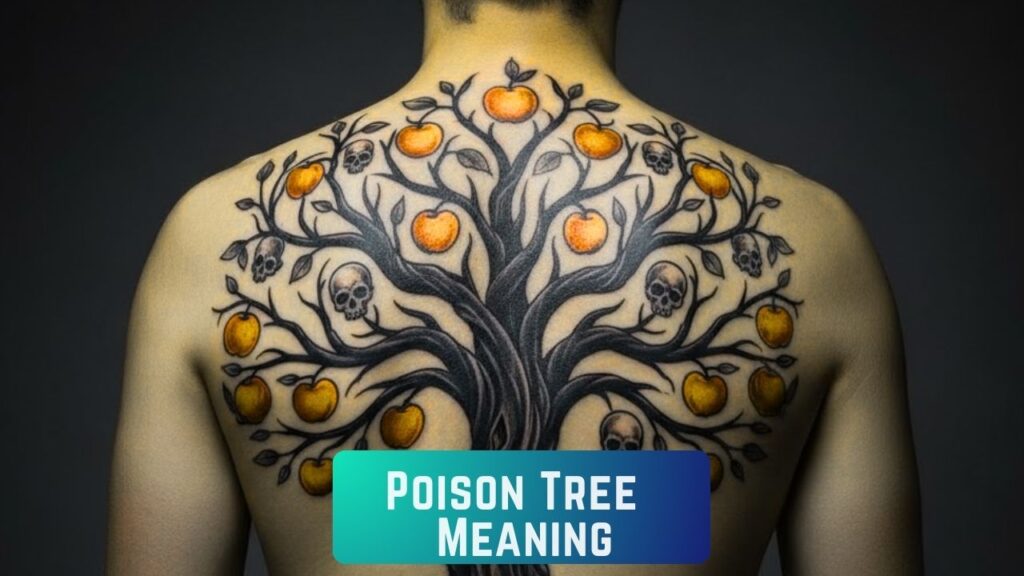
Poison Tree tattoo meaning
Body art featuring poison trees symbolizes personal transformation, overcoming toxicity, or acknowledging dark experiences. These tattoos serve as permanent reminders of lessons learned through painful relationships or internal struggles.
| Design Element | Symbolism |
| Dark twisted branches | Complicated past trauma |
| Skull in roots | Death of old toxic self |
| Withering leaves | Letting go of resentment |
| Burning tree | Purging negativity |
| Blooming flowers | Growth after hardship |
Popular tattoo interpretations:
- Memorial for toxic relationship survived
- Strength symbol for overcoming anger
- Artistic appreciation of Blake’s poetry
- Gothic aesthetic preference
- Personal philosophy about emotional honesty
Placement significance:
- Back piece = Major life transformation
- Forearm = Visible reminder of lessons
- Chest = Close to heart emotional significance
- Thigh = Personal journey kept private
- Neck = Bold statement about authenticity
A Poison Tree meaning each stanza
Blake’s four-stanza masterpiece progresses through distinct emotional stages. Each section builds upon the previous, creating a devastating narrative arc about cultivated revenge.
Stanza 1 Analysis: Establishes the central contrast between healthy expression (anger told to friend ends) and toxic suppression (anger hidden from foe grows). The simple language makes the moral lesson accessible.
Stanza 2 Breakdown:
- Watering with tears = Self-pity fueling resentment
- Sunning with smiles = Hypocritical friendliness
- Deceitful wiles = Manipulative behavior
- Day and night = Constant obsession
- Growing = Escalating malice
| Stanza | Key Image | Emotional Process |
| One | Telling/not telling | Honesty vs. concealment |
| Two | Watering/sunning | Nurturing hatred |
| Three | Bright apple | Temptation created |
| Four | Dead enemy | Hollow victory |
Stanza 3 Focus: The metaphorical fruit appears,a bright shining apple that the foe steals at night. This biblical echo recalls Eden’s forbidden fruit, suggesting sin and temptation.
Stanza 4 Resolution: The speaker finds the enemy dead beneath the tree, responding with glad satisfaction,a chilling conclusion that reveals how revenge corrupts the avenger.
Poison tree meaning to jah
In Rastafarian philosophy, the poison tree represents Babylon system,the corrupt establishment spreading spiritual toxicity. Jah (God) teaches followers to avoid nourishing negativity that distances them from divine truth.
Rastafarian interpretation:
- Babylon as the ultimate poison tree
- Material greed poisoning spiritual growth
- Political oppression creating societal toxicity
- Ital living (natural lifestyle) avoiding poison
- Positive vibrations countering negative energy
Core principles:
- Rejection of corrupt systems
- Cultivation of love over hatred
- Natural living preventing spiritual pollution
- Unity dissolving divisive poison
- Truth as antidote to deception
Chat example: Rasta elder: “Don’t let Babylon plant poison trees in your heart, seen? Keep Jah love growing instead.”
Poison Tree meaning xxtenations
Late rapper XXXTentacion frequently referenced dark imagery including poison trees to express emotional turmoil, betrayal, and internal demons. His artistic vision connected Blake’s themes with modern struggles around mental health and violence.
| XXX’s Usage | Contextual Meaning |
| Song lyrics | Personal battles with depression |
| Social media | Warning about fake friends |
| Album art | Visual representation of pain |
| Interviews | Metaphor for toxic influences |
| Legacy | Symbol of transformation |
Thematic connections:
- Inner demons as personal poison trees
- Industry betrayal representing toxic soil
- Fan relationships both nourishing and draining
- Redemption arc cutting down negative growth
- Posthumous meaning about legacy of pain and art
Fan interpretations:
- Tattoo tributes combining X’s symbols with tree imagery
- Memorial posts using poison tree for lost potential
- Lyric analysis connecting to Blake’s original poem
- Mental health discussions in fan communities
- Artistic influence on SoundCloud generation
Poison Tree Meaning Necklace
Jewelry featuring poison tree pendants serves as personal talismans representing protection from toxic influences or reminders of past struggles overcome. These accessories blend aesthetic appeal with deep symbolism.
Popular necklace designs:
- Blackened silver tree with skull roots
- Inverted tree showing underground poison
- Locket containing Blake’s poem excerpt
- Crystal branches representing healing
- Minimalist outline for subtle symbolism
| Material | Symbolic Enhancement |
| Sterling silver | Purity overcoming toxicity |
| Black onyx | Protection from negativity |
| Rose gold | Beauty emerging from pain |
| Wooden pendant | Natural grounding energy |
| Emerald accents | Growth and renewal |
Wearer intentions:
- Daily reminder to practice emotional honesty
- Conversation starter about mental health
- Memorial piece for ended toxic relationship
- Artistic expression of literary appreciation
- Spiritual protection against negative energy
Chat example: Friend: “Love that necklace! What’s the tree mean?” Wearer: “It’s a poison tree,reminds me never to let anger grow in silence again.”
Similar Terms & Alternatives
Several related concepts share thematic connections with poison tree symbolism. Understanding these alternatives enriches comprehension of metaphorical language around toxicity and growth.
Comparable expressions:
- Bitter root = Deep-seated resentment
- Festering wound = Unhealed emotional injury
- Viper’s nest = Concentration of dangerous elements
- Rotten seed = Corrupted beginning leading to bad outcomes
- Tainted well = Polluted source affecting everything
| Term | Primary Focus | Usage Context |
| Poison tree | Cultivated anger | Literary/artistic |
| Bitter root | Established resentment | Religious/therapeutic |
| Bad seed | Inherent corruption | Familial/societal |
| Toxic vine | Spreading negativity | Relationship advice |
| Dark garden | Collection of issues | Psychological |
Contextual substitutions:
- Grudge (simple, direct)
- Vendetta (active revenge)
- Animosity (formal, intellectual)
- Bad blood (colloquial, relationship-focused)
- Malice (legal, intentional harm)
Differences from Similar Words
While poison tree shares conceptual territory with related terms, distinct nuances separate these metaphors. Understanding these differences enables precise communication about emotional states.
Poison Tree vs. Bitter Root: The poison tree emphasizes active cultivation and growth process, while bitter root focuses on established foundation of resentment already deeply embedded.
| Comparison Point | Poison Tree | Bitter Root |
| Origin | Literary (Blake) | Biblical (Hebrews) |
| Focus | Growing process | Established state |
| Action | Nurturing negativity | Existing foundation |
| Outcome | Produced destruction | Spreads corruption |
| Remedy | Stop watering | Dig out completely |
Poison Tree vs. Bad Blood: Poison tree involves deliberate cultivation through deception, whereas bad blood describes mutual hostility between parties without implying calculated growth.
Key distinctions:
- Poison tree = One-sided nurturing of revenge
- Bad blood = Reciprocal animosity between groups
- Festering wound = Passive deterioration without active feeding
- Viper’s nest = Multiple dangers clustered together
- Tainted well = Source corruption affecting downstream
A Poison Tree summary
Blake’s poem narrates how suppressed anger toward an enemy grows into a deadly trap. The speaker waters this wrath with tears and suns it with deceptive smiles, producing a bright apple.
Plot progression:
- Speaker tells friend about anger,it ends
- Speaker hides anger from foe,it grows
- Speaker nurtures this wrath through false kindness
- Tree produces tempting fruit
- Enemy steals apple at night
- Speaker finds foe dead under tree in morning
The narrative warns that unexpressed emotions become poisonous, ultimately destroying both target and harborer of grudges.
A Poison Tree analysis
Blake employs simple rhyme scheme (AABB) and straightforward diction to deliver complex psychological insight. The deceptive simplicity mirrors the poem’s theme of hidden malice beneath friendly surfaces.
| Literary Device | Example | Effect |
| Metaphor | Anger as growing tree | Makes abstract emotion concrete |
| Allusion | Apple/Garden of Eden | Connects to sin and temptation |
| Contrast | Friend vs. foe treatment | Highlights moral choice |
| Irony | Smiles hiding malice | Shows deception’s role |
| Symbolism | Night theft | Represents sneakiness |
Structural analysis: Blake divides the sixteen lines into four quatrains, each advancing the narrative. The progression from emotion to action to consequence creates moral instruction.
Psychological depth:
- First-person narration implies universal human tendency
- Active verbs (watered, sunned, grew) show deliberate cultivation
- Passive victim (foe) highlights predatory nature
- Morning satisfaction reveals spiritual corruption
- No remorse expressed shows complete moral failure
A poison tree by william blake meaning
William Blake’s masterpiece serves as cautionary tale about emotional honesty. The central message argues that openly expressing anger resolves conflict, while concealing it breeds destructive consequences.
Blake’s philosophical context:
- Romantic emphasis on authentic emotion
- Critique of societal repression
- Religious symbolism questioning Christian forgiveness
- Political commentary on oppressed populations
- Psychological insight predating Freudian theory
Deeper meanings:
- Criticism of passive aggression
- Warning about revenge’s emptiness
- Exploration of human duplicity
- Meditation on sin’s consequences
- Celebration of honest communication
The poem’s enduring relevance stems from its universal truth: suppressed emotions poison both individual and relationships.
How People Use in Daily Conversations
Modern speakers employ poison tree references when discussing toxic relationships, workplace drama, family conflicts, and personal growth. The metaphor transcends literary origins to become everyday language.
Common conversational contexts:
Relationship advice: “Don’t keep watering that poison tree,either talk to him or move on completely.”
Workplace situations: “The whole department’s become a poison tree since Karen got promoted. Everyone’s smiling but plotting.”
Family dynamics: “My sister’s been growing a poison tree against mom for years. It’s gonna explode eventually.”
Self-reflection: “I realized I was cultivating poison trees in my head against people who didn’t even know I was upset.”
Mental health discussions: “Therapy helped me stop watering all these poison trees I’d planted from childhood.”
| Setting | Typical Usage | Meaning Conveyed |
| Social media | Vague-posting about enemies | Warning others |
| Therapy | Describing resentment | Clinical metaphor |
| Friend groups | Gossip about conflicts | Dramatic flair |
| Self-help | Personal growth language | Transformation |
| Dating apps | Profile red flags | Deal-breakers |
Text message examples:
Example 1: “Why you still following your ex? 🌳💀” “Not watering that poison tree anymore, just being civil”
Example 2: “Should I tell Jessica what I really think?” “Yes! Don’t plant poison trees, just be honest”
Example 3: “My manager keeps smiling while sabotaging me” “Classic poison tree situation,document everything”
Professional contexts: HR professionals use poison tree when discussing toxic work cultures. Mediators reference it during conflict resolution. Therapists employ the metaphor to help clients visualize unhealthy emotional patterns.
Educational usage: Teachers discuss Blake’s poem in literature classes, but students apply poison tree meaning to peer conflicts, cyberbullying, and social media drama. The concept helps young people understand emotional consequences.
Creative applications: Writers, musicians, and artists draw inspiration from poison tree symbolism when exploring themes of betrayal, revenge, and redemption. The image appears in album covers, book titles, and visual art.
FAQs
What does Poison Tree meaning symbolize in relationships?
Poison Tree meaning represents hidden resentment growing destructive when partners avoid honest communication about hurt feelings and unresolved conflicts.
How does Poison Tree meaning relate to mental health?
Poison Tree meaning illustrates how suppressing emotions creates psychological toxicity, teaching that expressing feelings prevents internal damage and relationship harm.
What’s the Poison Tree meaning in tattoos?
Poison Tree meaning in tattoos symbolizes survival of toxic relationships, personal transformation, or reminder to practice emotional honesty and avoid harboring grudges.
Where did Poison Tree meaning originate?
Poison Tree meaning originated from William Blake’s 1794 poem exploring how nurtured anger becomes deadly, using botanical metaphor for psychological processes.
Why is Poison Tree meaning relevant today?
Poison Tree meaning remains relevant because modern relationships still suffer from passive aggression and unspoken resentment, making Blake’s lesson timeless.
Conclusion
The Poison Tree meaning transcends centuries, offering timeless wisdom about emotional honesty and the dangers of cultivated revenge. Whether encountered in poetry, tattoos, music, or everyday conversations, this powerful symbol reminds us that suppressed anger grows toxic, ultimately poisoning both bearer and target.
Blake’s simple metaphor captures complex psychological truth: expressing feelings heals, while hiding them destroys. Understanding Poison Tree meaning empowers us to choose authenticity over deception, resolution over revenge, and emotional health over festering resentment.
